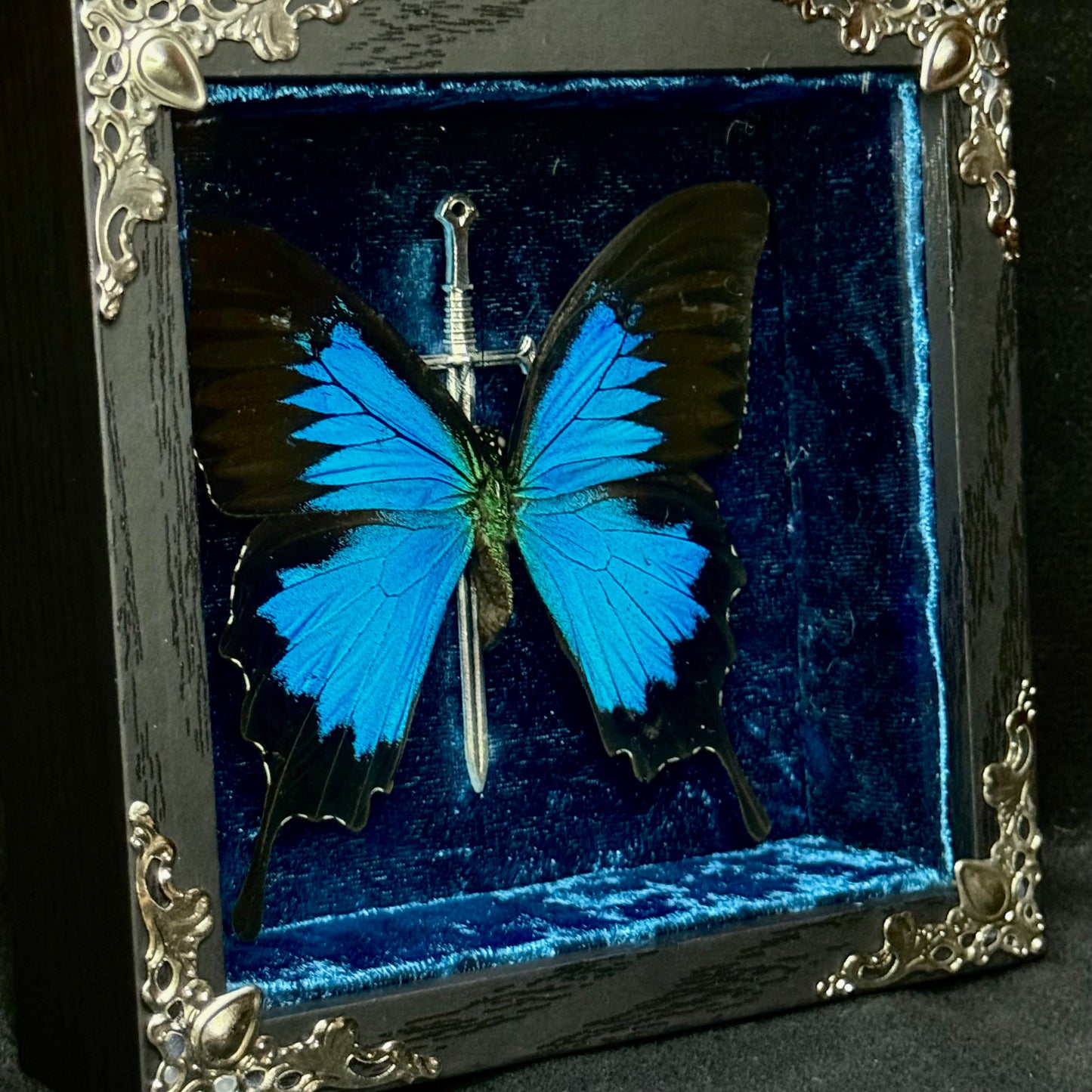
Papilio Ulysses — Blue Emperor Framed Butterfly
Ethically sourced
Couldn't load pickup availability
This Papilio ulysses, known as the Blue Emperor or the Ulysses Butterfly, is most commonly found in the rainforests of far North Queensland, Australia, where locals often catch nothing more than a flash of blue before it's gone again. That's not an accident. Its wings hold two completely different faces: on top, an electric, structural blue, created by microscopic light-refracting scales rather than pigment, and underneath, a plain, camouflaged brown-black. Close its wings mid-flight and it seems to disappear entirely, only to flash back into view a moment later. It's even named for Ulysses, the mythological wanderer, for its long, erratic, hard-to-follow flight. 🦋
I set this one with a small blade resting beneath its wings, the hilt just below where the head meets the thorax, against deep blue crushed velvet and held inside a black frame trimmed in ornate silver filigree. The pairing feels like a continuation of a theme I keep returning to: the sword as something sharp, protective, and unyielding, and the butterfly as something fleeting, soft, and built to vanish the moment it needs to. Steel and wing, holding still together in the same frame.
This piece is a beautiful fit for a gothic-leaning space, a witchy vanity or bookshelf, a bar cart, or any wall that could use a little bit of edge alongside its beauty. It stands just as well on its own as it does grouped with other framed specimens.
Product Dimensions: 6 Inches x 6 Inches
Sourcing Location: Australia or Papua New Guinea
Ethical Sourcing Information: This Blue Emperor lived out its full, natural lifespan on a licensed butterfly farm before being ethically preserved. These farms raise butterflies specifically to support and repopulate wild populations, so no butterfly here was taken from the wild, and its life cycle was allowed to run its natural course.

Is it Real? Is it Cruel?
Yes, this is a real butterfly — and no, none was harmed to make it beautiful. Every specimen is ethically and sustainably sourced, collected only after its natural lifespan from butterfly farms and conservation programs that fund the protection of wild habitats. What you hold is the dignified afterlife of a creature that lived its full span — preserved, not taken.